

What Is the Ideal Size and Placement of Convex Mirrors in Underground Car Parks?
Underground car parks come with built-in blind spots. Tight ramps, sharp corners and rows of concrete columns block a driver’s view long before they reach the danger. A car reversing out of a bay or turning onto a ramp often has no warning of oncoming traffic until it is right in front of them. Convex mirrors fix this by giving drivers a wide view exactly where they need it most.
This article by Safety Xpress covers the mirror sizes, placement rules and materials that make underground car parks safer for drivers, pedestrians and property managers alike.
Why do convex mirrors matter in underground car parks?
Convex mirrors matter because they remove blind spots at corners, ramps and lane merges where drivers cannot see approaching vehicles or pedestrians in time to react. Underground car parks are darker, narrower and more congested than open-air parking, which raises the risk of low-speed collisions and near misses with people on foot.
A mirror placed at the right corner gives a driver several extra seconds of warning, often the difference between a close call and an actual crash. This matters most in high-traffic sites such as shopping centres, hospitals and apartment buildings, where pedestrians frequently cross vehicle paths near lift lobbies.
Choosing the ideal convex mirror size: the diameter-to-distance matrix
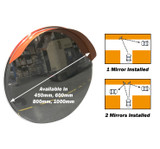
The right mirror size depends on the viewing distance a driver needs to cover, and as a general rule, every metre of distance calls for roughly 25mm to 30mm of mirror diameter. A mirror that is too small shows a narrow, distorted image that is hard to read at speed, while one too large for a short distance can cause drivers to misjudge how close a vehicle actually is.
| Viewing Distance | Recommended Diameter |
|---|---|
| Up to 10m | 450mm |
| 10m to 15m | 600mm |
| 15m to 20m | 600mm to 800mm |
| 20m and beyond | 800mm or larger |
Ceiling height also plays a part. Lower clearances often suit a slightly smaller mirror mounted closer to the corner, since drivers have less time to process a wide field of view before reaching the intersection. Curved or angled corners may need two mirrors working together to cover the full blind spot.
Where should convex mirrors be positioned in a parking garage?
Convex mirrors should be positioned at blind corners, ramp junctions, entry and exit points and pedestrian crossings, mounted between 2m and 2.4m from the ground so they sit above vehicle roof lines without cutting into headroom clearances. This height keeps the mirror visible to cars and taller vehicles like vans and small trucks, while staying clear of low-ceiling services such as sprinkler pipes.
Mirrors work best angled to face directly into the blind spot rather than straight ahead, so a driver sees the full width of the intersecting lane. Placement should avoid high-vibration zones near roller doors or plant equipment, since constant movement can knock a mirror out of alignment. Where two lanes merge or a ramp curves sharply, pairing a mirror on each side of the blind spot gives a complete view instead of a partial one.
Material selection: polycarbonate vs acrylic vs stainless steel
The right material comes down to how exposed the mirror is to impact, weather and vandalism. Polycarbonate mirrors are the toughest option, holding up well in high-traffic areas or sites with a history of damage since the material resists cracking. Acrylic mirrors are lighter with clearer optical quality, a good fit for lower-risk indoor areas where clarity matters more than impact resistance. Stainless steel-backed mirrors are built for the harshest conditions, including outdoor ramps exposed to weather and temperature swings.
Compliance guidelines: meeting Australian parking space standards
Convex mirrors should be selected and positioned to support the sightline and safety requirements set out in Australian parking facility design standards, such as AS 2890.1, which cover aisle widths, ramp gradients and driver visibility. Poor sightlines and undersized mirrors are a common finding in car park safety audits, and getting the size and placement right the first time avoids costly retrofits down the track. Councils, builders and facility managers working on new car parks or upgrades should factor mirror specification into the design stage rather than as an afterthought.
Get the right mirror setup for your car park
Getting the convex mirror size, placement and material right is one of the most cost-effective ways to reduce collisions and protect pedestrians underground. It comes down to matching diameter to viewing distance, mounting at the correct height and angle and choosing a material suited to the site’s traffic and exposure.
Safety Xpress stocks a full range of convex mirrors for car parks, warehouses and loading docks across Australia, backed by a team who can help match the right size and placement to your site. Get in touch with our specialists to talk through your layout and find the perfect fit.
Recent Posts
-

Traffic Signs for Car Parks
What Traffic Signage Does My Car Park Actually Need? The Complete Compliance Guide There is no singl …2nd Oct 2026 -

Which Safety Mirror Is Right For Your Space?
Which Safety Mirror Is Right For Your Space? Improve Visibility and Reduce Blind Spots in Workplaces …14th Aug 2026 -
What Is the Ideal Size and Placement of Convex Mirrors in Underground Car Parks?
Underground car parks come with built-in blind spots. Tight ramps, sharp corners and rows of concret …5th Aug 2026